
Pallet racking load capacity is the maximum weight a racking system can safely support, expressed as a load per beam level and a total bay load. Exceeding these limits risks structural collapse, equipment damage, and serious injury. This guide explains how to calculate beam and frame capacities, what factors affect safe working loads, and how UK standards govern racking safety in commercial warehouses.
Key takeaways
- Check beam pair capacity and bay capacity separately, as both limits apply independently.
- Weigh loaded pallets on a calibrated scale; nominal product weights exclude packaging and pallet boards.
- A standard wooden pallet adds 20–25 kg; stretch wrap and cardboard add a further 5–15 kg.
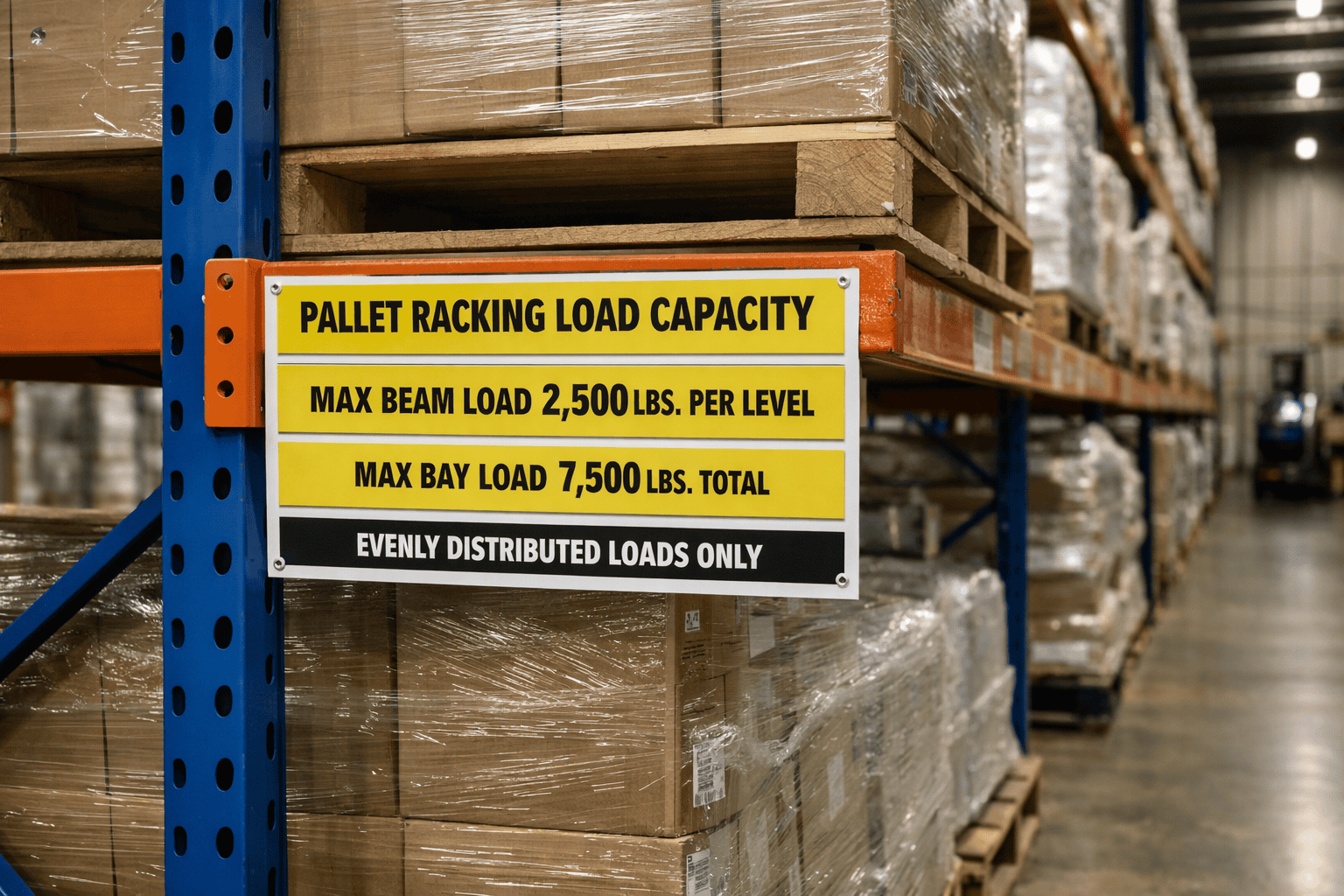
- Every aisle end must display a load notice under HSG76 and SEMA codes of practice.
- PUWER 1998 places a legal duty on employers to keep racking safe and within rated capacity.
- Exceeding the rated limit on any single component, whether beam, upright, or base plate, makes the whole system unsafe.
- Schedule a SEMA-approved racking inspection at least once every 12 months, regardless of visible damage.
What Load Capacity Means for Pallet Racking Systems
Source: Article content — typical beam pair capacity ranges by beam length for standard pallet racking profiles
Check the load rating on every beam level before placing a single pallet, not just the system capacity. Pallet racking operates with two distinct load limits: the beam pair capacity, which governs how much weight a single shelf level can hold, and the bay capacity, which sets the maximum load the entire upright frame can support across all levels combined.
Beam pair ratings typically range from 1,000 kg to 4,000 kg depending on beam length and profile depth. A standard 2,700 mm beam pair commonly carries 2,000–2,700 kg. The upright frame imposes a separate ceiling: even if each beam level sits within its individual limit, the cumulative load across all levels must not exceed the frame’s rated capacity, which varies with height, bay configuration, and the specific steel grade used.
Floor loading adds a third constraint that many operators overlook. Industrial concrete floors in UK warehouses are typically rated between 20 kN/m² and 50 kN/m², and a fully loaded racking bay concentrates significant force through four baseplate contact points. If the floor rating cannot support the point loads, structural failure becomes a risk independent of the racking’s own capacity.
Selecting a pallet racking supplier that provides verified load data, including beam test certificates and upright capacity tables, gives you the accurate figures needed to calculate safely. Generic or unverified load ratings should never be used for live warehouse planning.
Key Components That Determine Racking Load Limits
| Component | Load Role | Key Risk Factor |
|---|---|---|
| Upright Frames | Carries cumulative weight of all loaded beam levels | Taller frames deflect more, reducing safe working capacity |
| Beam Pairs | Governs weight per individual shelf level | Capacity falls as span increases — always check manufacturer load tables |
| Connectors & Locking Clips | Transfers load between beam and upright | Loose or damaged clips concentrate stress; SEMA recommends checking every routine inspection |
| Floor Anchoring | Maintains stability under static load and forklift impact | Insufficient concrete fixing transfers lateral loads poorly, risking frame movement |
Exceed the rated limit on any single component and the entire system becomes unsafe. Four structural elements set the actual load limits for any pallet racking installation.
Upright frames carry the cumulative weight of every loaded beam level. Capacity depends on steel gauge, frame height, and bracing pattern. Taller frames deflect more under load, reducing safe working capacity compared with shorter configurations.
Beam pairs govern how much weight a single shelf level holds. Capacity falls as span increases, so always verify against the manufacturer’s load tables for the specific beam profile and span installed.
Connectors and locking clips transfer load between beam and upright. A loose or damaged clip concentrates stress on fewer contact points. SEMA recommends checking clip engagement during every routine inspection.
Floor anchoring affects stability under both static load and forklift impact. Uprights fixed to insufficient concrete transfer lateral loads poorly, increasing the risk of frame movement under heavy or off-centre pallets.
Unevenly loaded pallets shift stress towards one beam end, locally exceeding rated capacity even when total pallet weight stays within the stated limit. Centre the load on the beam pair and distribute weight evenly across the pallet base.
Step-by-Step Load Capacity Calculation Method
Skipping the beam deflection check is the most common calculation error in pallet racking assessments. The inputs must come from verified manufacturer data, not estimates.
Weigh loaded pallets directly to record the unit load weight for each position. Nominal product weights rarely account for packaging, wrapping, or pallet board weight, so round up to the nearest 50 kg. Multiply that figure by the number of pallet positions per beam level, then compare it against the beam pair rating on the racking label, which HSE guidance HSG76 requires on every bay.
For total bay capacity, add the beam pair demands across all loaded levels and confirm the upright frame rating exceeds that sum. If it does not, reduce the number of loaded levels before use. Divide the total bay load by the base plate footprint area to produce a kN/m² pressure figure, then have a structural engineer confirm the slab can sustain it, particularly on mezzanine floors or older industrial concrete.
UK Standards and Legal Requirements for Racking Safety
HSG76, the Health and Safety Executive’s primary warehouse racking guidance, requires that racking systems are installed, inspected, and maintained in line with the manufacturer’s specification and the relevant SEMA codes of practice. Every aisle end must display a load notice stating the maximum beam load, bay load, and any configuration restrictions. Under PUWER 1998, employers carry a legal duty to keep racking safe throughout its service life.
SEMA recommends an annual inspection by a qualified Rack Safety Inspector, supported by weekly or monthly in-house checks from a trained Rack Safety Officer. Damage must be assessed against SEMA’s classification system before a bay returns to use: red-category damage requires immediate unloading and replacement; amber-category damage requires assessment within four weeks. Relying on visual judgement after a forklift impact is one of the most common compliance failures identified during warehouse audits. Working with a specialist racking company ensures load notices remain accurate and post-damage assessments are completed by someone qualified to make the call.
Common Load Calculation Mistakes and How to Avoid Them
Operatives often record a product’s nominal weight from a purchase order, which excludes the pallet board, stretch wrap, and added packaging. A standard wooden pallet adds 20–25 kg; wrap and cardboard add a further 5–15 kg. Weigh loaded pallets on a calibrated floor scale before entering any figure into a calculation.
Bay capacity is an independent structural limit set by the upright frame, and it is frequently lower than the combined beam pair ratings. Using beam ratings to infer total frame capacity can produce figures that exceed what the uprights can safely carry.
Mixed or off-centre pallet positions impose additional bending stress beyond what rated capacity assumes. Every pallet should sit flush within the beam span, centred front to back.
A bent upright or cracked beam clip reduces real-world capacity below the original rating. SEMA guidance requires a qualified inspection following any collision or visible deformation before a bay returns to service at its previous rated load.
Floor slab condition is a less obvious but consequential factor. A slab with insufficient bearing strength or existing cracks can fail at loads well within the racking’s rated limits. Confirm slab specification with a structural engineer before installing any high-density or drive-in system.
When to Commission a Professional Racking Inspection
Schedule a professional racking inspection at least once every 12 months, even without visible damage. Forklift impacts, beam adjustments, and incremental overloading accumulate damage that in-house checks routinely miss. A qualified SEMA-approved rack inspector assesses structural integrity, identifies frame twist and base plate distortion, and produces a written report satisfying PUWER 1998 compliance requirements.
Trigger an unscheduled inspection immediately after any forklift collision, partial collapse, or reports of unusual beam deflection. Waiting for the annual cycle after a known impact creates direct liability. A pallet rack safety inspection carried out promptly establishes whether the damaged bay should be taken out of service, repaired, or cleared for reduced loading.
Warehouses that introduce heavier pallets or reconfigure bay heights mid-year should commission an interim inspection before resuming full loading. Any structural change invalidates existing load notices until a competent person re-certifies the system.
Frequently Asked Questions
How do you calculate pallet racking load capacity in the UK?
Divide the total safe working load of each beam level by the number of pallets it holds. Then confirm the upright frame capacity covers the combined load of all beam levels above it. Cross-check both figures against the racking manufacturer’s data plates and ensure they comply with BS EN 15512 standards.
What is the difference between beam load capacity and bay load capacity?
Beam load capacity is the maximum weight a single beam level can hold, distributed evenly across both beams. Bay load capacity covers the entire upright frame section, combining all beam levels within it. Always check both figures: a bay may reach its frame limit before any individual beam reaches its rated maximum.
Which factors affect the safe load capacity of pallet racking?
Check the rack manufacturer’s load notices first. These specify the maximum bay and shelf loads, which depend on upright frame capacity, beam strength, and beam-to-upright connector ratings. Floor condition, pallet weight distribution, and seismic or forklift impact loads also reduce safe working limits in practice.
How can you find the load rating for existing pallet racking?
Every compliant racking system must display a load notice placard near the bay entrance. Check this first, as it states the maximum bay load, beam load, and floor loading assumptions. If no placard is present, contact the original manufacturer using the frame serial number, or commission a SEMA-approved racking inspector to assess and rate the installation.
Do UK pallet racking systems need load notice signs and regular inspections?
SEMA guidelines and the Provision and Use of Work Equipment Regulations 1998 (PUWER) require every racking bay to display a load notice showing maximum bay, shelf, and floor load ratings. Inspections must be carried out by a trained person at least annually. A competent person should also perform a documented detailed inspection every 12 months minimum.