
To convert kinematic viscosity in centistokes (cSt) to dynamic viscosity in centipoise (cP), multiply the kinematic viscosity by the fluid’s density in grams per cubic centimetre (g/cm³): cP = cSt × density. Kinematic viscosity measures how freely a fluid flows under gravity, while dynamic viscosity measures its internal resistance to shear force. This guide explains the relationship between the two units, walks through the conversion formula step by step, and covers how to find or estimate fluid density for common liquids.
Key takeaways
- Multiply kinematic viscosity (cSt) by density (g/cm³) to get dynamic viscosity (cP).
- Density must be measured at the same temperature as kinematic viscosity.
- Using a 15°C density value for a 40°C fluid can overstate results by 3 to 5%.
- Engine oil, hydraulic fluid, and fuel specs typically express viscosity in cSt.
- Water shifts from 1.002 cP at 20°C to 0.653 cP at 40°C, a 35% drop.
- Density in g/cm³ is required; convert kg/m³ values by dividing by 1,000 first.
- Supplier safety data sheets and NIST fluid property databases provide verified density figures.
What Kinematic and Dynamic Viscosity Measure
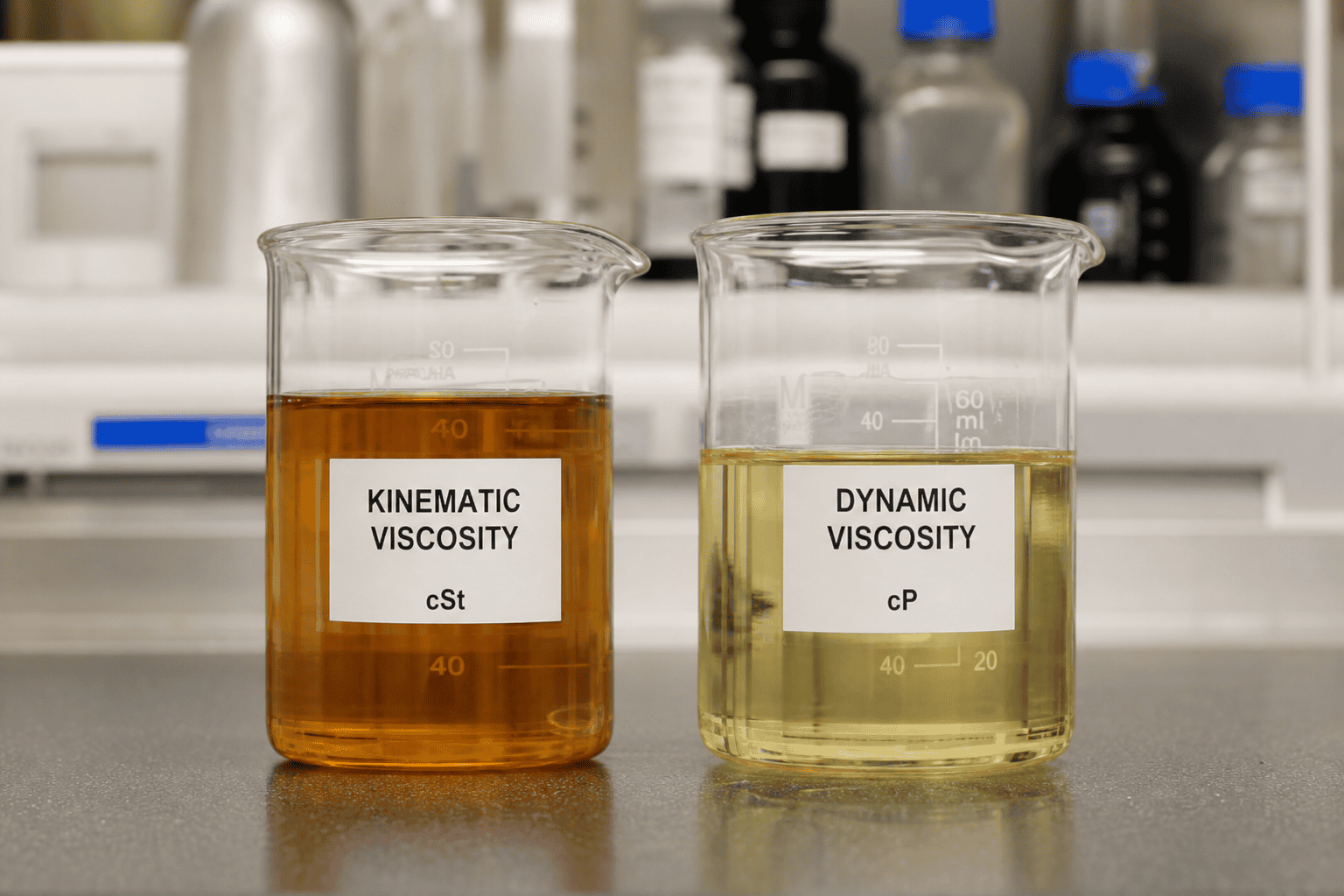
Measure kinematic viscosity when you need to understand how a fluid flows under gravity alone. It captures flow resistance relative to density, expressed in centistokes (cSt). Engine oil ratings, hydraulic fluid specifications, and fuel classifications use kinematic viscosity because gravity-driven flow reflects real operating conditions.
Dynamic viscosity measures the internal friction a fluid generates when an external force moves one layer past another. Expressed in centipoise (cP), it quantifies shear stress at a given flow rate, independent of density. Rheology labs, coating processes, and pharmaceutical manufacturing rely on it because those applications involve pumps and mixers applying direct force.
| Property | Kinematic Viscosity | Dynamic Viscosity |
|---|---|---|
| Unit | Centistokes (cSt) | Centipoise (cP) |
| What it measures | Flow resistance relative to density under gravity | Internal friction from an externally applied force |
| Density dependence | Includes density as a divisor | Independent of density |
| Typical applications | Engine oil ratings, hydraulic fluid specs, fuel classifications | Rheology labs, coating processes, pharmaceutical manufacturing |
| Driving force | Gravity-driven flow | Pump or mixer applied force |
The two properties connect through density: kinematic viscosity equals dynamic viscosity divided by fluid density. Converting between them requires knowing density at the same temperature, since both viscosity and density shift with temperature change.
The Conversion Formula: cSt to cP Using Density
Multiplying kinematic viscosity by fluid density gives you dynamic viscosity directly. The relationship is:
Dynamic viscosity (cP) = Kinematic viscosity (cSt) × Density (g/cm³)
This works because centistokes already incorporate density as a divisor. Reversing that division by multiplying back through density recovers the absolute measure of internal friction that dynamic viscosity represents.
Density must be measured at the same temperature as the kinematic viscosity reading. A fluid tested at 40°C will have a different density at 20°C, and mixing values from different temperatures introduces proportional error into the result. For petroleum-based oils, density typically falls between 0.85 and 0.90 g/cm³ at 15°C, but drops measurably as temperature rises.
When density data is unavailable, specific gravity (the ratio of a fluid’s density to water at 4°C) substitutes directly in the formula, since water’s density equals 1.0 g/cm³. ASTM International publishes standard test methods, including ASTM D4052 for density measurement, that ensure the input values feeding this conversion are consistent and comparable across laboratories.
How to Find the Correct Density Value for Your Fluid
Using a density figure measured at the wrong temperature is the most common error in this conversion. Density falls as temperature rises, so a value taken at 15°C will overstate dynamic viscosity if the fluid operates at 40°C or 100°C. Always match the density measurement to the temperature at which kinematic viscosity was recorded.
Published density data appears in supplier safety data sheets, NIST fluid property tables, and standards such as ASTM D1298 and ISO 3675 for petroleum-based oils. These sources report density in g/cm³ or kg/m³; use g/cm³ directly in the cSt × density formula, or divide a kg/m³ figure by 1,000 first.
For blended or proprietary fluids without published data, measure density directly using a calibrated pycnometer or digital density meter at the target temperature. A difference of 0.02 g/cm³ can produce errors of several centipoise, affecting pump selection or lubrication system design.
Worked Examples Across Common Fluids and Temperatures
Water at 40°C has a kinematic viscosity of roughly 0.658 cSt and a density of 0.992 g/cm³, giving 0.653 cP, measurably below the 1.002 cP at 20°C. That 35% shift across 20°C illustrates why both values must match the same temperature.
A mid-grade ISO VG 46 hydraulic oil at 40°C typically shows 46 cSt and density near 0.870 g/cm³, giving 40.02 cP. A heavier ISO VG 100 oil at the same temperature yields around 87.5 cP. Density differences between grades are small, so kinematic viscosity drives most of the variation.
Glycerol at 20°C produces approximately 1,488 cP from 1,180 cSt and 1.261 g/cm³. At 30°C those figures drop to roughly 628 cP, a near-halving over 10°C that confirms why engineers specify temperature alongside every viscosity figure.
Diesel fuel at 40°C runs between 2.0 and 4.5 cSt by grade. At 3.0 cSt and 0.840 g/cm³, dynamic viscosity is 2.52 cP. Cross-checking against published reference data from Engineering Toolbox helps catch unit mismatches before they cause errors.
Common Errors and How to Check Your Results
A mismatch between measurement temperatures causes most incorrect results. If kinematic viscosity was measured at 40°C but density comes from a 15°C data sheet, the output can be overstated by 3–5% for light oils. Always verify both figures share the same reference temperature before multiplying.
Unit confusion is the second most frequent error. The formula requires density in g/cm³, but many supplier sheets and NIST fluid property tables express it in kg/m³, so divide by 1000 first. A density entered as 870 instead of 0.870 produces a result roughly 1000 times too large.
Cross-checking against published cP data for a known fluid is the most reliable verification step. Water at 40°C should yield approximately 0.653 cP; anything outside 0.64–0.67 cP signals a density error. ISO viscosity grade data sheets from manufacturers such as Shell or Mobil include both kinematic and dynamic viscosity at 40°C and 100°C as a direct reference.
Rounding density to fewer than three decimal places introduces compounding error at higher viscosities. A hydraulic oil at 100 cSt rounded from 0.876 to 0.88 g/cm³ shifts the final cP value by roughly 0.4 cP. For high-viscosity flu
Frequently Asked Questions
How do you convert kinematic viscosity in cSt to dynamic viscosity in cP step by step?
Multiply the kinematic viscosity (in cSt) by the fluid’s density (in g/cm³) at the same temperature. The result is dynamic viscosity in cP.
Formula: cP = cSt × density (g/cm³)
For example, a fluid with a kinematic viscosity of 50 cSt and a density of 0.87 g/cm³ has a dynamic viscosity of 43.5 cP.
What formula links kinematic viscosity, dynamic viscosity and fluid density?
Dynamic viscosity (cP) equals kinematic viscosity (cSt) multiplied by fluid density in grams per cubic centimetre (g/cm³). Written as a formula: cP = cSt × density. Rearranging gives you kinematic viscosity when dynamic viscosity and density are known: cSt = cP ÷ density.
Why must fluid density be known before converting cSt to cP?
Multiply kinematic viscosity (cSt) by the fluid’s density in g/cm³ to get dynamic viscosity (cP). Without density, the equation has no solution. The same kinematic viscosity value produces different dynamic viscosity results depending on whether the fluid is water, oil, or a solvent.
At what temperature should viscosity and density values be measured for an accurate conversion?
Both values must be measured at the same temperature. Viscosity and density change significantly with temperature, so mixing readings from different conditions introduces error. For most industrial and laboratory applications, 25°C or 40°C are standard reference points. Always specify which temperature applies when reporting results.
What is the difference between centistokes (cSt) and centipoise (cP)?
Centistokes (cSt) measures how freely a fluid flows under gravity, without accounting for its weight. Centipoise (cP) measures the force needed to move one layer of fluid over another. Converting between them requires the fluid’s density, since cP = cSt × density (g/cm³).