
SUS316 offers superior corrosion resistance compared to SUS304, primarily because it contains 2–3% molybdenum, which SUS304 lacks. That addition makes SUS316 significantly more resistant to chloride attack, pitting, and crevice corrosion in marine and chemical environments. This article examines the composition, corrosion performance, and practical applications of both grades to help engineers and buyers select the right alloy for their specific conditions.
Key takeaways
- SUS316 contains 2 to 3% molybdenum; SUS304 contains none. Check the material certificate first.
- SUS316’s PREN of 25 to 26 gives it measurably stronger chloride resistance than SUS304’s 18 to 20.
- In coastal, marine, and pool environments, SUS304 can pit visibly within months.
- Food processing and pharmaceutical applications require SUS316 due to chloride-based cleaning agents.
- SUS316 costs roughly 20 to 30% more; only specify it where corrosion exposure genuinely justifies the premium.
- Both grades weld and machine similarly; the main fabrication risk is sensitisation during welding.
- If sustained chloride exposure applies from seawater, coastal air, or brackish water, specify SUS316.
What Sets SUS304 and SUS316 Apart Chemically
Check the material certificate before ordering either grade: the molybdenum content listed there is the single fastest way to distinguish them. SUS316 contains 2–3% molybdenum; SUS304 contains none. That addition raises the pitting resistance equivalent number (PREN) of SUS316 to roughly 25–26, compared with 18–20 for SUS304, giving it measurably stronger resistance to chloride attack.
Both grades share an austenitic structure built around iron, chromium (17–19%), and nickel (8–12%). The chromium forms a passive oxide layer that blocks oxidation in most environments. Where SUS304 falls short is in chloride-rich conditions: chloride ions break down that passive layer locally, initiating pitting corrosion. Molybdenum in SUS316 stabilises the passive film under chloride exposure, slowing the breakdown process significantly.
| Property | SUS304 | SUS316 |
|---|---|---|
| Chromium content | 17–19% | 17–19% |
| Nickel content | 8–12% | 8–12% |
| Molybdenum content | None | 2–3% |
| Carbon maximum | 0.08% | 0.08% |
| PREN (approx.) | 18–20 | 25–26 |
| Chloride resistance | Moderate — pits above ~200 ppm | High — stabilised passive film |
| Typical cost premium | Baseline | ~20–30% above SUS304 |
| Weld sensitisation risk | Comparable (use 304L for heavy work) | Comparable (use 316L for heavy work) |
Carbon content is nearly identical between the two at 0.08% maximum, so weld sensitisation risk is comparable unless the low-carbon variants SUS304L or SUS316L are specified for heavy fabrication work.
How Each Grade Performs Against Corrosion in Real Conditions
In chloride-heavy environments such as coastal installations, marine hardware, and swimming pool fittings, SUS316 consistently outperforms SUS304 by resisting pitting and crevice corrosion that would otherwise initiate within months. The molybdenum content stabilises the passive oxide layer under chloride attack, delaying breakdown at concentrations that cause SUS304 to pit visibly. At chloride levels above roughly 200 ppm, SUS304 becomes a poor long-term choice for wetted components.
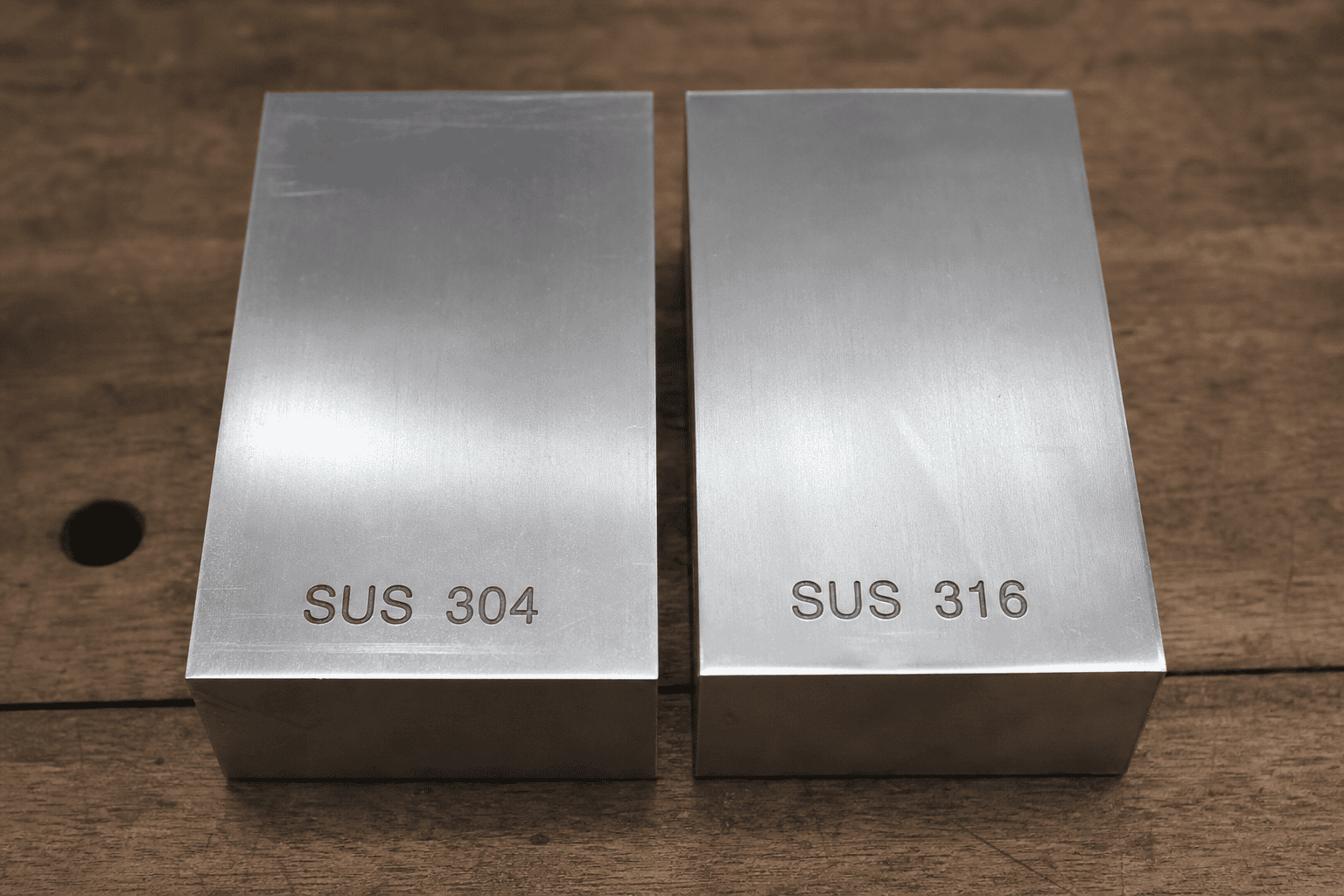
SUS304 performs reliably in freshwater systems, food processing equipment, and indoor architectural applications where chloride exposure is low. Its passive film handles atmospheric oxidation, mild acids, and most organic compounds without degradation. Pump housings operating in centrifugal fluid systems that circulate clean water or neutral liquids rarely need the upgrade to SUS316.
Temperature raises the stakes for both grades. Above 60°C, chloride stress corrosion cracking accelerates sharply, and SUS316’s advantage widens. In pharmaceutical or chemical processing where hot saline or acidic solutions circulate, SUS316 is the minimum specification, not an optional upgrade.
Industries and Applications Where Grade Choice Matters Most
Recommended applications for SUS316:
- Marine & offshore: Seawater chloride levels exceed SUS304's passive layer stability threshold — SUS316 is the minimum acceptable grade for deck hardware, fasteners, and structural fixings.
- Food processing & pharmaceutical: Chloride-based cleaning agents used routinely; SUS316 prevents pitting that compromises hygiene standards.
- Chemical processing: Wetted components handling sulphuric or phosphoric acid require SUS316 for molybdenum-enhanced acid resistance.
- Swimming pool fittings: High chloride concentrations in pool water make SUS316 the reliable long-term choice.
- Hot saline or acidic systems: Above 60°C, SUS316 is the minimum specification, not an optional upgrade.
Recommended applications for SUS304:
- Indoor architectural: Handrails, cladding, and decorative fixtures in low-chloride indoor environments.
- Freshwater systems: Pump housings and pipework circulating clean water or neutral liquids rarely need SUS316.
- Food processing (dry/low-chloride): Where chloride cleaning agents are not used routinely.
- General fabrication: Storage vessels and structural components with minimal chemical exposure.
- Cost-sensitive projects: Where corrosion risk does not arise, the saving over SUS316 is fully justified.
Specifying the wrong grade in a chloride-rich environment is a costly mistake. In food processing and pharmaceutical manufacturing, where chloride-based cleaning agents are used routinely, SUS304 surfaces pit under repeated chemical exposure, compromising hygiene standards and shortening service life. SUS316 is the standard choice for both sectors.
Marine and offshore applications are the most demanding. Seawater chloride concentrations exceed the threshold at which SUS304 loses passive layer stability, making SUS316 the minimum acceptable grade for deck hardware, fasteners, and structural fixings. Weld on hooks in coastal settings illustrate this directly: SUS316 maintains structural integrity where SUS304 would show visible corrosion within one to two seasons.
SUS304 performs reliably in indoor architectural applications, fresh water systems, and general fabrication where chloride exposure is minimal. Handrails, cladding, and storage vessels handling low-salinity fluids all fall within its competence, and the cost saving over SUS316 is justified because the corrosion risk does not arise.
Chemical processing plant handling sulphuric or phosphoric acid typically specifies SUS316 for wetted components, as the molybdenum content improves resistance to acidic media. For ambient-temperature applications with no chemical exposure, SUS304 remains the more economical grade.
Cost, Availability, and Fabrication Differences
- PREN of 25–26 versus 18–20 for SUS304 — measurably stronger chloride attack resistance
- Molybdenum stabilises passive film, delaying pitting at chloride concentrations that damage SUS304
- Required minimum grade for marine, offshore, pharmaceutical, and chemical processing applications
- Greater advantage widens above 60°C where chloride stress corrosion cracking accelerates
- Improved resistance to sulphuric and phosphoric acid media
- Costs roughly 20–30% more than SUS304 due to molybdenum content
- Produced in lower volumes, meaning longer lead times and reduced stock availability
- Cost premium is unjustified in low-chloride environments such as indoor architectural or freshwater applications
- No performance advantage over SUS304 in ambient-temperature, non-chemical exposure settings
SUS316 costs roughly 20–30% more than SUS304, a gap driven almost entirely by its molybdenum content. SUS304 is produced in far greater volumes, which means shorter lead times and more competitive pricing. Specifying SUS316 without a clear corrosion justification adds cost without a corresponding performance benefit.
Both grades machine, weld, and form by similar methods. The main fabrication risk is sensitisation during welding: heat exposure between 425°C and 860°C allows chromium carbides to precipitate at grain boundaries, reducing corrosion resistance in the heat-affected zone. Low-carbon variants SUS304L and SUS316L control this risk without changing base mechanical properties.
In mild indoor environments, SUS304 delivers adequate performance at lower cost. Where chloride contact is confirmed, the premium for SUS316 typically pays back through reduced maintenance and extended service life. Always verify the grade on the material test certificate; visual inspection alone cannot distinguish the two grades reliably.
How to Choose the Right Grade for Your Project
The decision turns on one question: will the component face sustained chloride exposure? Coastal air, seawater splash, chlorinated cleaning agents, and brackish water all exceed the point where SUS304’s passive layer becomes unreliable. Corrosion-induced pitting reduces cross-section and load capacity before visible failure occurs, making SUS316 the correct specification for marine or offshore load-bearing equipment, including chain hoists.
Where chloride exposure is absent or intermittent, the 20–30% cost premium for SUS316 is difficult to justify. Internal food-grade fittings cleaned with chloride-based agents are the clear exception, since repeated chemical contact shifts the environment into SUS316 territory regardless of ambient conditions.
Above 500°C, both grades are susceptible to sensitisation; specify SUS316L where post-weld heat treatment is not possible. Continuous high-temperature service calls for duplex or high-alloy steels instead. When budget constrains selection, reserve SUS316 for components with direct chloride contact and use SUS304 for structural elements in protected positions.
Frequently Asked Questions
What is the main difference in corrosion resistance between SUS304 and SUS316?
SUS316 resists corrosion more effectively than SUS304, primarily because it contains 2–3% molybdenum. This addition significantly improves resistance to chloride attack and pitting, making SUS316 the preferred choice for marine, chemical, and coastal environments. SUS304 performs well in general atmospheric conditions but corrodes faster when exposed to salt or acidic solutions.
How does molybdenum in SUS316 improve resistance to chlorides and salt exposure?
Molybdenum strengthens the passive oxide layer that forms on stainless steel surfaces. This makes it far harder for chloride ions to penetrate and trigger localised corrosion, known as pitting. In salt-heavy environments such as coastal sites, marine equipment, or chlorinated water systems, SUS316’s 2-3% molybdenum content provides meaningfully superior protection compared to SUS304.
When is SUS304 sufficient instead of SUS316 for corrosion-prone environments?
Choose SUS304 for indoor or mild outdoor environments where moisture is incidental rather than persistent. It performs reliably against fresh water, food acids, and atmospheric humidity. Reserve SUS316 for chloride-rich settings such as coastal installations, marine equipment, or chemical processing where sustained exposure would corrode SUS304 prematurely.
How do cost and service life compare when choosing SUS304 or SUS316?
SUS316 costs roughly 20–30% more than SUS304 due to its molybdenum content. In chloride-heavy or acidic environments, that premium pays for itself through reduced corrosion failures and longer service intervals. In dry or low-humidity indoor settings, SUS304 delivers comparable longevity at a lower upfront cost.
Which industries or applications commonly require SUS316 over SUS304 for better corrosion resistance?
SUS316 contains 2–3% molybdenum, which gives it measurably stronger resistance to chlorides and acidic compounds. This makes it the standard choice in marine engineering, pharmaceutical manufacturing, food processing equipment, and chemical handling systems. Medical implants and coastal construction also specify SUS316 where prolonged exposure to aggressive environments would cause SUS304 to pit or corrode prematurely.